Department of Information Technology: Powering the Digital Revolution
At Sri Harshini College of Engineering and Technology for Women, our IT department is committed to shaping women technologists who will drive innovation in enterprise systems, cloud computing, and digital transformation. We bridge the gap between theoretical knowledge and industry demands through a dynamic curriculum that evolves with technological advancements.
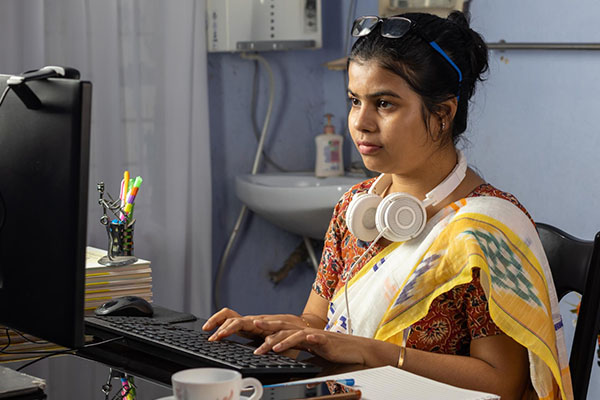
Why Choose IT at Sri Harshini?
Our IT program offers a specialized focus on software engineering, database management, network security, and emerging domains like Blockchain and DevOps. Students gain hands-on experience in our cutting-edge labs featuring high-end servers, virtualization platforms, and cybersecurity tools, preparing them for real-world IT challenges.
We emphasize practical learning through industry projects, where students develop solutions like ERP systems, mobile applications, and AI-powered business tools. Our strong corporate partnerships with leading IT firms provide opportunities for internships, certifications, and placements in roles ranging from system architects to data analysts.
With a unique emphasis on women’s leadership in technology, we cultivate not just coding skills but also project management, teamwork, and entrepreneurial thinking. Our graduates are equipped to excel in diverse IT sectors including fintech, e-governance, and enterprise software development.
Vision & Mission
VISION
To develop the Department of Information Technology as a center of excellence that empowers women graduates with strong technical competence, ethical values, innovative thinking, and lifelong learning skills to deliver effective information technology solutions for industry, research, and societal needs.
MISSION
- To provide strong theoretical knowledge and practical skills in Information Technology and core computing areas through quality teaching and modern learning resources.
- To promote innovation, problem solving, and continuous learning by engaging students in projects, research activities, and emerging information technologies.
- To prepare women students for successful careers and higher studies by nurturing professional competence, ethical values, and social responsibility.
PO’s (Program Outcomes)
- PO1 — Engineering Knowledge: Apply the knowledge of mathematics, science, engineering fundamentals, and an engineering specialization to the solution of complex engineering problems.
- PO2 — Problem Analysis: Identify, formulate, review research literature, and analyze complex engineering problems reaching substantiated conclusions using principles of mathematics, natural sciences, and engineering sciences.
- PO3 — Design/Development of Solutions: Design solutions for complex engineering problems and design system components or processes to meet specified needs considering public health, safety, cultural, societal, and environmental aspects.
- PO4 — Conduct Investigations of Complex Problems: Use research-based knowledge and research methods including design of experiments, analysis, and interpretation of data to provide valid conclusions.
- PO5 — Modern Tool Usage: Create, select, and apply appropriate techniques, resources, and modern engineering and IT tools to complex engineering activities, with an understanding of their limitations.
- PO6 — The Engineer and Society: Apply reasoning informed by contextual knowledge to assess societal, health, safety, legal, and cultural issues relevant to professional engineering practice.
- PO7 — Environment and Sustainability: Understand the impact of professional engineering solutions in societal and environmental contexts and demonstrate knowledge of and need for sustainable development.
- PO8 — Ethics: Apply ethical principles and commit to professional ethics and responsibilities and norms of engineering practice.
- PO9 — Individual and Team Work: Function effectively as an individual, and as a member or leader in diverse teams and in multidisciplinary settings.
- PO10 — Communication: Communicate effectively on complex engineering activities with the engineering community and society at large, including writing reports, design documentation, making presentations, and giving/receiving clear instructions.
- PO11 — Project Management and Finance: Demonstrate knowledge and understanding of engineering and management principles and apply these to one’s work as a member and leader in a team to manage projects and in multidisciplinary environments.
- PO12 — Life-long Learning: Recognize the need for, and have the preparation and ability to engage in independent and life-long learning in the broadest context of technological change.
PEO’s (Program Educational Objectives)
- PEO1: Graduates will apply fundamental principles of information technology and computing to analyze, design, and implement effective IT solutions for real-world problems.
- PEO2: Graduates will pursue successful careers in industry, higher education, research, or entrepreneurship by continuously upgrading their technical and professional skills.
- PEO3: Graduates will demonstrate ethical conduct, teamwork, leadership qualities, and social responsibility while contributing positively to technological and societal development.
PSO’s (Program Specific Outcomes)
- PSO1: Ability to design, develop, and manage information systems using programming skills, databases, networking concepts, and modern IT tools.
- PSO2: Ability to apply emerging technologies such as web technologies, cloud computing, cybersecurity, data analytics, and mobile applications to solve industry-oriented and societal problems.
Faculty List
| Name of the Faculty | Designation |
|---|---|
| Dr. Juvvi Naga Raju | Professor |
| Anburaj A | Assistant Professor |
| Nadendla Hakeem Akram | Assistant Professor |
| Uppiretla Ravi | Assistant Professor |
| Rajasekaran Nalani | Associate Professor |
| Alavalapati Nancharamma | Assistant Professor |
Syllabus
We are updating the content. Please come back here and visit for updated content.
Exam Notification
We are updating the content. Please come back here and visit for updated content.
Previous Question Papers
We are updating the content. Please come back here and visit for updated content.